
How to Choose a Wedding Venue: What to Know Before You Book
Choosing a wedding venue is one of the first BIG decisions you’ll make when planning your wedding — and after recently going through the venue search myself, I can tell you there is so much more to consider than whether you love how a venue looks.
Hi! I’m Samantha, Rental Specialist at Baystate Tent, wedding coordinator, and a 2027 bride. I spend my days helping couples plan tents, rentals and layouts for weddings all over New England, so I see firsthand how much the venue you choose can affect everything that comes afterward. When it was finally my turn to start venue shopping, I thought I knew exactly what I was looking for.
And then I actually started touring venues…I learned A LOT.
Some venues I loved online completely underwhelmed me in person. Some were absolutely beautiful but came with restrictions that just didn’t work for the wedding we wanted. Others seemed reasonably priced until I started adding up everything we’d be required to bring in or every vendor we’d be required to use.
Ultimately, the venue we chose wasn’t exactly what I originally pictured. But, it was way better for the wedding we actually wanted to have.
So, if you’re wondering how to choose a wedding venue, here’s everything I would consider after going through the process myself — with the added perspective of someone who works in the wedding industry every day.
How Do I Choose the Right Wedding Venue?
To choose the right wedding venue, start with four things: your budget, estimated guest count, general location and time of year. From there, compare venues based on what they actually include, how comfortably they accommodate your guests, their rules and timing, required vendors, rain plan, amenities and total expected cost.
And please, don’t choose based on the venue fee or pretty photos alone.
You’re not just choosing a property. You’re choosing the rules, timeline, vendors, amenities and costs that come with it.
TL;DR: How to Choose a Wedding Venue
- Know your budget, approximate guest count, general location and time of year before you start touring.
- Decide which amenities and experiences actually matter to you.
- Compare the total expected cost of each venue, not just the venue fee.
- Tour in person and look beyond what you’ve seen on Instagram.
- Understand required vendors, restrictions, timing and the rain plan.
- Read the contract, cancellation policies, and terms before you pay a deposit.
1. Start With Your Budget, Guest Count, Location + Time of Year
Before you start falling in love with venues, get the basics figured out.
You absolutely do not need your entire wedding planned. You don’t need to know your flowers, bridesmaid dresses or tablescape yet. But you should have a general idea of what you can spend, how many people you’re inviting, where you’re willing to get married and what time of year you’re considering.
Those four things will eliminate a LOT of venues before you ever need to schedule a tour!
How Many People Can Fit in a Wedding Venue?
Your approximate guest count is one of the most important things to know before choosing a wedding venue. You don’t need your final RSVP count, but you should have a rough guest list and make sure the venue can comfortably accommodate your must-have guests.
And I emphasize comfortably for a reason.
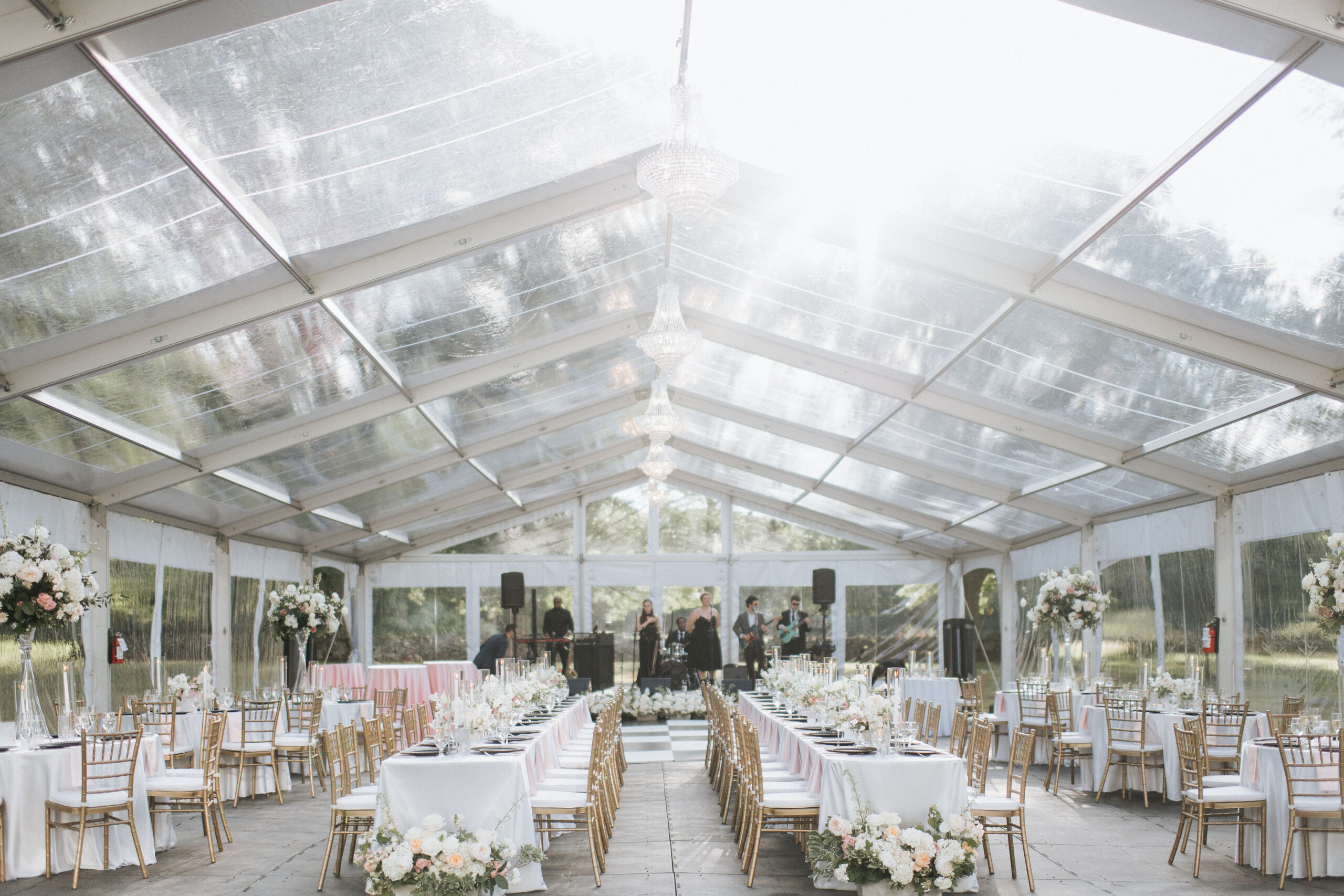
A venue might advertise a capacity of 200 people. Great! But what does the space actually look like with 200 people? Is there still room for a dance floor? A DJ or band? A bar? Buffet or food stations? Does everyone fit comfortably, or are we squeezing tables into every possible inch because technically the fire code says 200 people can be in the room?
This is something we run into at Baystate all the time when we’re creating wedding layouts. Guest count is only one piece of the puzzle — we also need room for the dance floor, bar, DJ or band, catering setup and comfortable aisles between everything.
When you’re considering a venue near its maximum capacity, ask to see an actual floor plan or photos from a wedding with a similar guest count.
There’s a BIG difference between “200 people fit” and “this venue works well for a 200-person wedding.”
Decide How Far You’re Willing to Go
Don’t necessarily box yourself into one town or even one state!
When my fiancé and I started looking, we knew we wanted to stay in New England. A destination wedding wasn’t realistic for our families, so New England became our general boundary. Beyond that, we looked alllll over the region.
I’m SO glad we did.
We eventually found our venue in Connecticut, which probably wouldn’t have happened if I had decided from the beginning that we needed to stay within a tiny radius of home!
Decide how far you’re actually willing to go, but don’t make your search unnecessarily restrictive. Your perfect venue might be an hour farther away than you originally expected.
How Do Wedding Venue Prices Change by Season?
Wedding venue pricing can change depending on the time of year and day of the week, especially here in New England.
Our peak wedding season generally runs from June through October, with June and September being especially busy months. If you have your heart set on a Saturday in September, start looking early! You’re competing for some of the most popular wedding dates of the year, and venues may have higher peak-season pricing or minimums during these months.
The day of the week can make a difference too. Saturday is typically the most expensive and in-demand day, while Thursday, Friday and Sunday weddings may come with lower venue pricing or minimums.
That doesn’t mean every vendor will charge more because you’re getting married during peak season. Pricing structures vary from company to company. For example, here at Baystate, our rental pricing doesn’t change based on the wedding season or day of the week. You’re more likely to see seasonal or day-of-week pricing differences with venues and caterers.
If you’re flexible, it’s always worth asking whether a venue offers different pricing for off-season months or non-Saturday weddings. But if you’ve always dreamed of a September Saturday in New England, go for it! Just know you’re choosing one of the most popular times to get married, so start your venue search early and budget accordingly.
2. Decide What Actually Matters to YOU in a Wedding Venue
Before you start comparing venues, figure out what your actual must-haves are — and be honest with yourself about why they’re must-haves.
Wedding trends are everywhere, and I think it’s really easy to confuse what’s popular with what you genuinely love. Do you actually love the rustic barn vibe, or have you just seen SO many beautiful barn weddings that it feels like what a wedding is supposed to look like? Do you really want a coastal wedding, or is that your best friend’s dream wedding? Do you actually want a black-tie wedding, or do you just feel like you need one for your wedding to look good on TikTok?
And listen, if you LOVE the barn, want to get married by the ocean, or have dreamed about a black-tie wedding forever — DO IT. The point isn’t to avoid trends. It’s to make sure you’re choosing things because you actually love them, not because you’ve seen them enough times to think you’re supposed to.
The same goes for the practical stuff. Maybe having everyone stay onsite is non-negotiable. Maybe you want complete freedom to choose your vendors. Maybe having an after-party is a must. Maybe you couldn’t care less about any of those things and would much rather have an all-inclusive venue where almost everything is handled for you.
I would actually make a list and separate it into must-haves, would-be-nice, and don’t-really-care. Because once you start touring beautiful venues, it becomes VERY easy to convince yourself that something you cared about isn’t that important — or suddenly start caring about something just because a venue has it.
This was probably one of the biggest things I learned during my own venue search. I went into it thinking the look of the venue was going to be one of my biggest priorities. Once we actually started looking, I realized that flexibility, access to the property, accommodations and the overall experience mattered to me SO much more.
Figure out what matters to you before you start falling in love with properties.
Style vs. Amenities: What I Learned During My Own Venue Search
Going into wedding planning, I would’ve LOVED to get married at a fancy historic New England mansion.
I love history. I love old architecture. I love that romantic, grand mansion look. I thought that was going to be a huge part of finding my venue. Then I started actually researching those properties.
Many of the mansions I looked at had very strict rules. You couldn’t do this or that. You had to use specific vendors. You couldn’t be onsite until the ceremony. There might not be an after-party option. You couldn’t stay onsite. And I slowly realized that those things mattered to me just as much as how the venue looked!
But I also don’t think the answer is to completely throw your aesthetic out the window for a venue with great amenities.
If you don’t like rustic weddings whatsoever, booking a barn just because it checks every other box probably isn’t going to make you happy — especially if there’s no realistic way to transform that barn into a space that feels like you. Your venue is a HUGE part of the overall look and feel of your wedding, and there are some things no amount of flowers or décor can change.
The better compromise is finding a venue that gives you the amenities and experience you want while still giving you a foundation you can turn into your vision.
That’s ultimately what we did! The venue we chose is still a beautiful historic property, but it isn’t the fancy mansion I originally imagined. Instead, we get a huge property, accommodations for our wedding party for the entire weekend, flexibility with our vendors and timing, and the ability to create the reception space we want.
And that’s the important difference: I didn’t choose a venue I disliked aesthetically just to get better amenities. I chose a venue where the aesthetic was flexible enough that we could make it ours.
And for what it’s worth, I still wanted that romantic mansion vibe somewhere — so we took our engagement photos at the Rhode Island State House!
Your venue doesn’t have to fulfill every single piece of your wedding vision, but you should be realistic about what you can and can’t change.
Your dream venue and your dream wedding aren’t necessarily the same thing. But your venue still needs to give you the foundation for your dream wedding.
And remember: You can change décor, but décor can only change so much. You can’t change the venue’s rules.
Wedding Day vs. Wedding Weekend
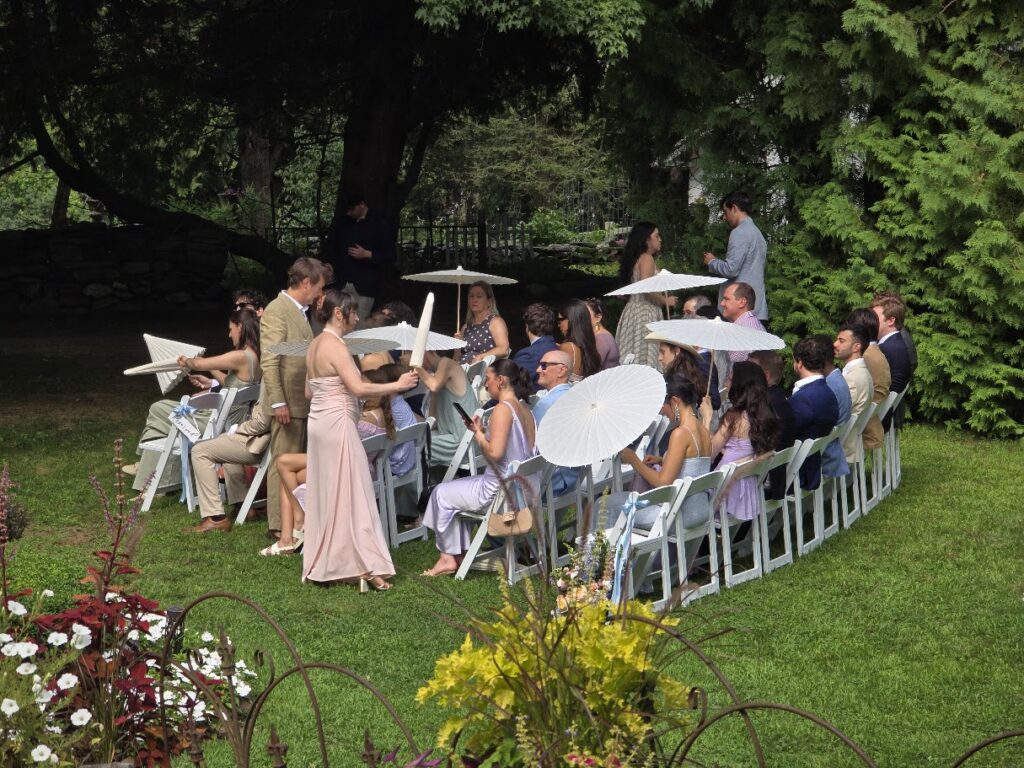
Some venues give you access for just the wedding day, while others are designed for a full wedding weekend — with time to rehearse, stay onsite, host additional events, and get ready without feeling rushed.
I’m personally a wedding-weekend lover. I love being able to settle into the property, spend more time with everyone, and extend the celebration beyond a few hours.
But you might not care AT ALL, and that’s completely fine! If you only need/want the venue for your wedding day, there’s no reason to pay for an entire weekend.
The important thing is knowing which experience you want before you book — and asking exactly when your access to the property begins and ends.
3. Research Wedding Venues BEFORE You Tour
I am a huge advocate for doing a lot of research before scheduling venue tours.
You can learn SO much before you ever step onto the property!
Make a Wedding Venue Comparison Spreadsheet
Yes, I made a spreadsheet…Of course I did! If you know me, you know. If you’re trying to figure out how to choose a wedding venue without touring every property in New England, a spreadsheet makes the process SO much easier.
I tracked things like:
| Venue + Property | Costs + Inclusions | Rules + Experience |
|---|---|---|
| Style / Vibe | Venue fee | Getting-ready access |
| Guest capacity | Food/beverage minimum | Rehearsal onsite? |
| Location/distance from home | Tables + chairs included? | Outside vendors allowed? |
| Indoor/outdoor spaces | Linens included? | Required vendors? |
| Rain plan | China/glassware | Planner required? |
| Getting-ready suite? | Catering | Décor restrictions |
| Overnight accommodations onsite? | Tent/rain-plan rentals | Curfew |
| Guest lodging nearby | Restrooms | After-party allowed? |
| Wedding weekend or one day | Generator/power | Pets allowed? |
| Heating/air conditioning | Additional fees | Vendor load-in/out |
Your spreadsheet doesn’t have to look exactly like mine.
Maybe you couldn’t care less whether your venue allows dogs, but having your dog there is a must-have for someone else! Maybe onsite lodging is at the very top of your list. Maybe you care way more about having complete vendor freedom.
That’s the point of the spreadsheet. It forces you to figure out which things matter to you and gives you a way to compare venues that may otherwise be completely different!
You Don’t Need to Tour 20 Wedding Venues
A huge part of learning how to choose a wedding venue is knowing what to look for once you’re actually standing in the space. I only toured a handful of venues because I was super picky with my pre-tour vetting.
If I already knew a venue couldn’t accommodate our guest count, didn’t fit the budget, had restrictions we weren’t comfortable with or didn’t offer the amenities we wanted, I didn’t need to go tour it just to say I did.
That being said, I DO think touring different types of venues can be incredibly helpful.
Seeing an all-inclusive venue versus a blank-slate property, or a one-day venue versus a wedding-weekend property, can help you figure out what you’re actually willing to compromise on.
Do your homework first, then tour your serious contenders!
4. What Should I Look for When Touring a Wedding Venue?
When touring a wedding venue, look at the things professional wedding photos don’t necessarily show you: the condition of the property, included furniture, bathrooms, getting-ready spaces, heating and air conditioning, actual guest capacity and rain-plan spaces.
And I mean actually LOOK.
Don’t Choose a Wedding Venue Based on Instagram
I cannot stress this enough: a venue can look VERY different on Instagram than it does in person.
Obviously, venues are going to post their best photos. You’re seeing the perfect sunset, professional photography, thousands of dollars in florals, beautiful rentals and the property photographed from its absolute best angles.
Then you tour and see the reality:
- Are the chairs you’re going to be using old and beat up, or clean and new?
- Are the bathrooms clean and maintained?
- Does the building look run down? Or is it well taken care of?
- Is the getting-ready space somewhere you’d actually want to spend several hours?
And here’s one I can’t believe needs to be said: If you’re having a summer wedding, is there air conditioning?!
Also pay attention to how the property is presented during your tour. They know a potential client is coming to see it. If things feel neglected when they’re actively trying to sell you the venue, that’s something I would notice.
And remember that what you’re seeing in professional wedding photos may not be what comes with the venue. Those gorgeous chairs might be rentals. The draping may have cost thousands. The lighting, linens, bar and dance floor may all have been brought in. There’s absolutely nothing wrong with that!
As a rental company, we’re often the ones bringing those pieces into a venue! There’s absolutely nothing wrong with upgrading what a venue includes — just make sure you know which parts of the photos you’re falling in love with actually come with the property and which were brought in specifically for that wedding.
Can the Venue Handle Your Guest Count?
Don’t just take the venue’s maximum capacity at face value. While you’re touring, actually picture the room set for your guest count with everything else your wedding needs — tables and chairs, a dance floor, bar, DJ or band, catering setup, and enough space for guests to comfortably move around.
If you’re getting close to the venue’s maximum capacity, ask to see photos or a floor plan from a wedding with a similar guest count. A venue may technically fit 175 people, but that doesn’t necessarily mean you’ll love what the room looks or feels like with 175 people in it.
That feels much more natural and gets to the actual point without the rapid-fire questions.
Ask to SEE the Rain Plan
If any part of your wedding is outdoors, don’t just ask whether the venue has a rain plan — ask to see it.
A venue might tell you, “If it rains, we’ll move cocktail hour inside.” Great! But where? Does that space actually fit your guest count comfortably? If your outdoor ceremony has to move inside too, what does that setup look like?
Also ask whether a tent can be installed as a rain plan. Is there a designated area for one? Are you allowed to choose your own tent company, or does the venue have a required or preferred vendor? And most importantly, what would that rain plan actually cost you?
You should be able to picture your wedding on a beautiful sunny day and on a rainy one before you book.
The rain plan doesn’t have to be as exciting as Plan A, but it should be a plan you’d genuinely be okay with using. If you’d be devastated with the backup option, that’s something to think about before choosing the venue.
5. What Are the Hidden Costs of Wedding Venues?
The biggest hidden costs of wedding venues often come from items that aren’t included in the venue fee: catering and bar minimums, required vendors, rentals, restroom trailers, generators, tents, transportation, service charges and additional access or staffing fees.
This is why wedding venue pricing can be SO difficult to compare.
You’re rarely comparing apples to apples.
What’s Actually Included in the Wedding Venue Fee?
One venue may have a higher rental fee but include tables, chairs, linens, bathrooms, getting-ready suites and ceremony setup.
Another may look significantly less expensive but require you to bring almost everything in.
Neither is inherently better.
Ask:
- Are tables and chairs included?
- Are linens included?
- Is china or glassware included?
- Are ceremony chairs and setup included?
- Is there a getting-ready suite?
- What time can we access it?
- Is catering included?
- Is there a food and beverage minimum?
- Are there service charges, taxes or gratuities?
- Is a planner required?
- Are there adequate bathrooms?
- Is a restroom trailer required?
- Is additional power required?
- Is a tent required?
- Are there mandatory rentals?
- Are there additional setup or cleanup fees?
The venue with the lowest venue fee isn’t automatically the least expensive venue.
Price Required Rentals BEFORE You Book
This is one of the biggest pieces of advice I can give from the Baystate Tent side of things: get rental estimates before you book the property.
If the venue requires a tent, restroom trailer, generator, flooring or other infrastructure, don’t wait until six months later to find out what those pieces cost. For a tent especially, the price can vary significantly based on guest count, tent style, site conditions, flooring, lighting and everything else you’re putting underneath it.
If a venue requires something that isn’t included in the venue fee, treat it as part of the cost of booking that venue and get realistic pricing before you sign.
Need a restroom trailer? Get a quote. Need a generator or additional power? Find out what that costs. If the property requires a tent for the reception or as part of the rain plan, talk to a tent company, like Baystate Tent, and get an estimate based on your guest count and what you’ll actually need.
These expenses can add up quickly, and I wouldn’t rely on a venue simply saying, “You’ll need to rent bathrooms,” or “You can put a tent here if it rains.” Ask what they require, then go directly to the appropriate vendors and find out what those requirements will actually cost you.
It’s very easy to fall in love with a property and think, we’ll figure that out later. But a $10,000, $20,000 or even larger infrastructure expense can completely change whether that venue actually works within your budget.
If it’s required to make the venue work for your wedding, it’s part of the venue cost — even if you’re paying someone else for it.
6. Is an All-Inclusive Wedding Venue Worth It?
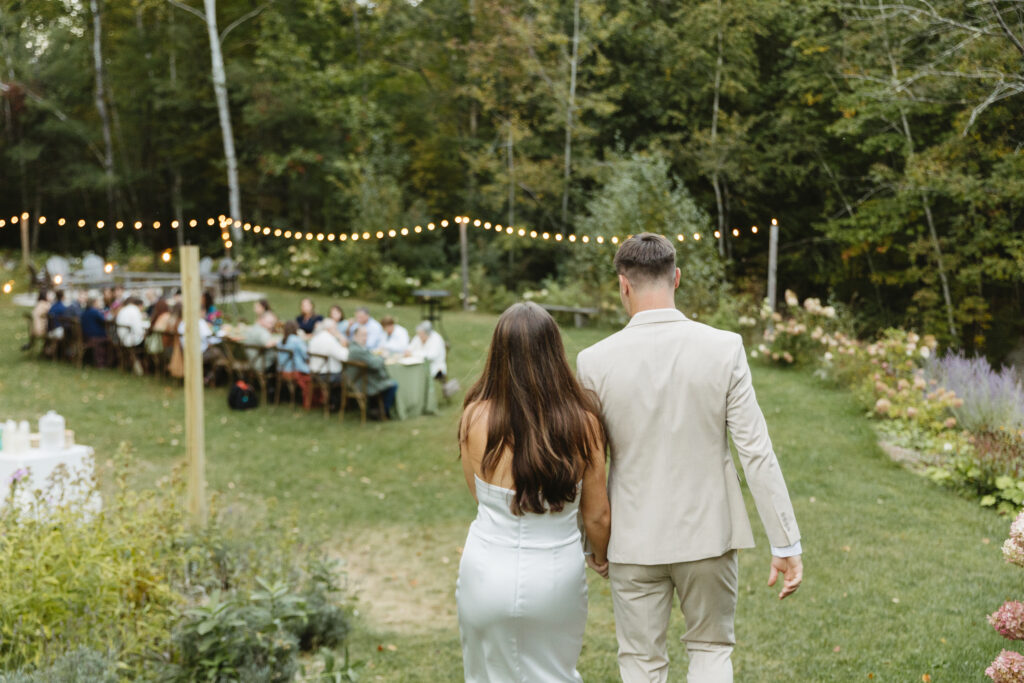
An all-inclusive wedding venue can absolutely be worth it if you value convenience and genuinely like the vendors, rentals, food and services included in the package. A blank-slate venue may be a better fit if customization and vendor flexibility are more important to you.
Neither is universally better!
What’s Included in an All-Inclusive Wedding Venue?
The term “all-inclusive” can mean something completely different from one wedding venue to another, so don’t assume you’re done budgeting just because a venue describes itself that way.
One venue’s package might include catering, bar service, tables, chairs, linens, china, staffing and coordination. Another might include the venue, catering and basic rentals but leave you responsible for everything else.
Ask for a detailed breakdown of exactly what’s included in the package AND what’s not. Are there upgrades you’ll likely want? Are certain chairs or linens included, but the ones you’ve been seeing in their photos cost extra? Is the bar included, or is alcohol additional? Are there service charges, gratuities or other fees on top of the package price?
All-inclusive venues can make planning SO much easier and give you a clearer picture of your overall costs upfront. Just make sure you’re comparing what you’ll actually want and use, not simply how long the included-items list is.
“Included” only has value if it’s something you would’ve paid for anyways.
Are Required or Exclusive Wedding Vendors a Red Flag?
Not necessarily! In fact, there can be some BIG benefits to working with a venue’s required or exclusive vendors.
If a venue has chosen one company to be its exclusive vendor, that relationship usually doesn’t happen casually. That vendor has likely gone through significant vetting, has extensive experience working at the property, knows the venue’s rules and logistics inside and out, and has earned enough trust that the venue is comfortable making them its only option. That says something!
We work closely with wedding venues ourselves, so I also see the that side of these relationships. When a venue trusts one company enough to make them an exclusive or preferred partner, that vendor usually knows the property incredibly well. They know where they can load in, what works in the space, what doesn’t, who to communicate with and how the venue operates on an actual wedding day.
That being said, research those vendors before you book the venue. Look at their work, read reviews, understand their pricing and make sure what they offer fits your budget and vision.
If you’ve always dreamed of using a certain caterer but the venue requires theirs, that’s something you need to know. If you have your heart set on a cake from a specific bakery but only one bakery is allowed, that matters. And if an exclusive rental company doesn’t carry anything close to the look you want, you should know that before signing.
If a vendor is exclusive, you’re essentially choosing that vendor when you choose the venue. Think of them as part of the package.
And that’s not necessarily a bad thing at all.
Requirements aren’t red flags. Surprises are!
7. Understand the Wedding Venue’s Rules + Timing
Every wedding venue has rules — and that’s completely normal. The important thing is understanding them before you book, because they can have a much bigger impact on your wedding than you might expect.
A venue’s rules can affect everything from when you and your vendors are allowed onsite to what décor you can use, when music has to end, whether you can have an after-party, and when rentals need to be removed.
Some venues offer a ton of flexibility, while others have very specific guidelines based on how the property operates. This is all about making sure the venue’s rules work with the wedding you’re actually planning.
What Wedding Venue Restrictions Should You Ask About?
If there’s something specific you’re envisioning, ask whether it’s allowed.
- Can you hang draping?
- Can you use real candles?
- Can you bring additional furniture into the venue?
- Can existing furniture be moved?
- Are sparklers allowed?
- Fireworks?
- Can décor be hung from the ceiling or walls?
You don’t want to find the perfect inspiration photo, plan around it for six months and then learn that the venue doesn’t allow it!
What Time Can You Access the Wedding Venue?
Don’t just ask how many hours the wedding package includes. Find out when you, your vendors AND your rentals can actually access the property.
- Can you get ready onsite that morning?
- Can you take photos before the ceremony?
- Can you rehearse onsite the day before?
- Can décor and rentals be delivered ahead of time — even the day before?
This can have a bigger impact on your budget than you might realize. From the rental side, for example, there can be a significant cost difference between a venue that allows us to install sometime Wednesday through Friday and one that requires everything to be delivered and installed Saturday morning before the wedding.
There is a HUGE difference between a venue where you can arrive Friday and stay through Sunday and one where everyone — including your vendors — has a very limited window to get in and out.
You might not need or care about extended access, and that’s completely fine. Just understand the timeline AND how it could affect your vendors before you book.
What Time Does the Wedding Have to End?
Make sure you know exactly when the reception has to end — and specifically ask about the music cutoff, because those aren’t always the same thing.
Also think about what you want to happen afterward. Is an onsite after-party allowed? Can guests stay and hang out after the music ends, or does everyone need to be off the property by a certain time?
An earlier curfew isn’t necessarily a dealbreaker, but it can change the wedding you’re planning. If you know your crowd is going to want to keep celebrating, you may need to move everyone to a hotel, bar or another location afterward. That means additional transportation, potentially another space, and more logistics to coordinate.
On the other hand, if you’re perfectly happy wrapping up at 10 PM, who cares?!
The important thing is making sure the venue’s timeline matches the kind of wedding you actually want to have — before you book it.
When Can Wedding Vendors Deliver and Pick Up?
8. What Are the Risks of an Outdoor Wedding Venue?
The biggest considerations with an outdoor wedding venue are weather, rain-plan costs, guest comfort, bathrooms, power and the additional infrastructure the property may require.
Outdoor weddings can be absolutely incredible! We LOVE outdoor weddings.
You just need to plan for the less glamorous stuff too.
Make Sure You’re Comfortable With the Rain Plan
If the venue doesn’t have a rain plan — or seems hesitant when you ask about one — I would pay attention.
You should know what happens if it rains before you book.
If a tent becomes the rain plan, find out whether you can choose your own tent company or whether the venue has a company it requires or regularly works with.
And then price it.
You should be comfortable with both Plan A and Plan B!
Will You Need Restrooms, Power or Other Infrastructure?
Outdoor and blank-slate properties may require things a traditional venue already has built in.
- Bathrooms.
- Power.
- Lighting.
- Catering infrastructure.
- Parking or transportation.
- Possibly a tent.
None of these things mean you shouldn’t choose the property – they mean you should understand the complete picture before you choose it.
9. Should You Consider a Tented or Backyard Wedding?
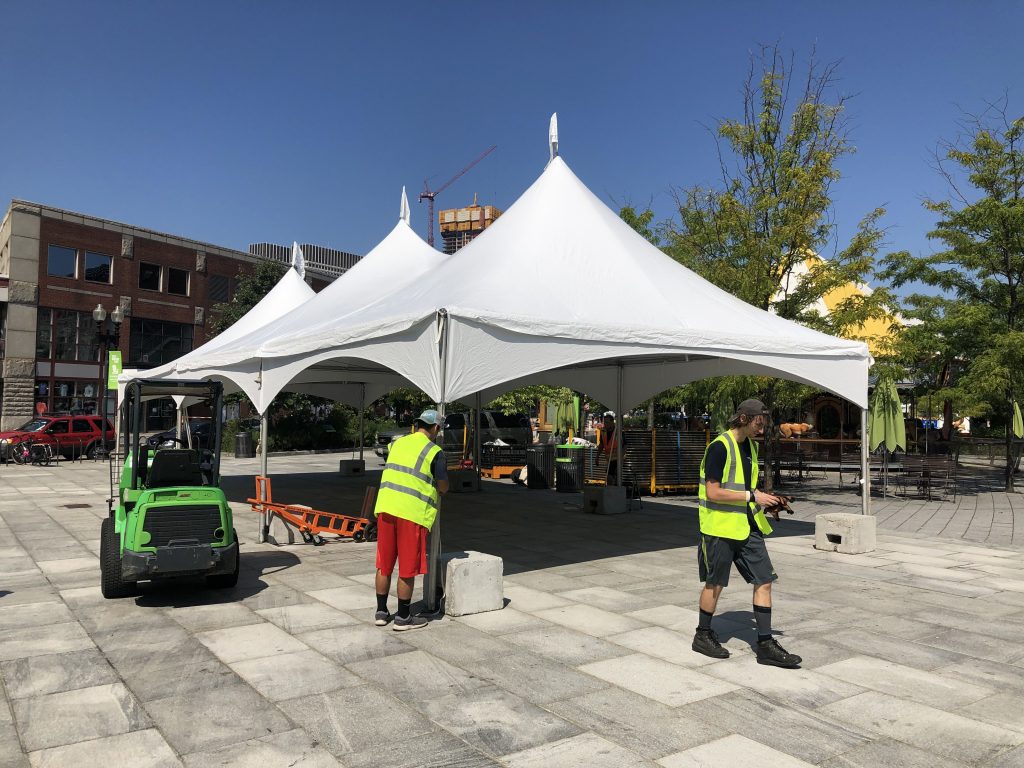
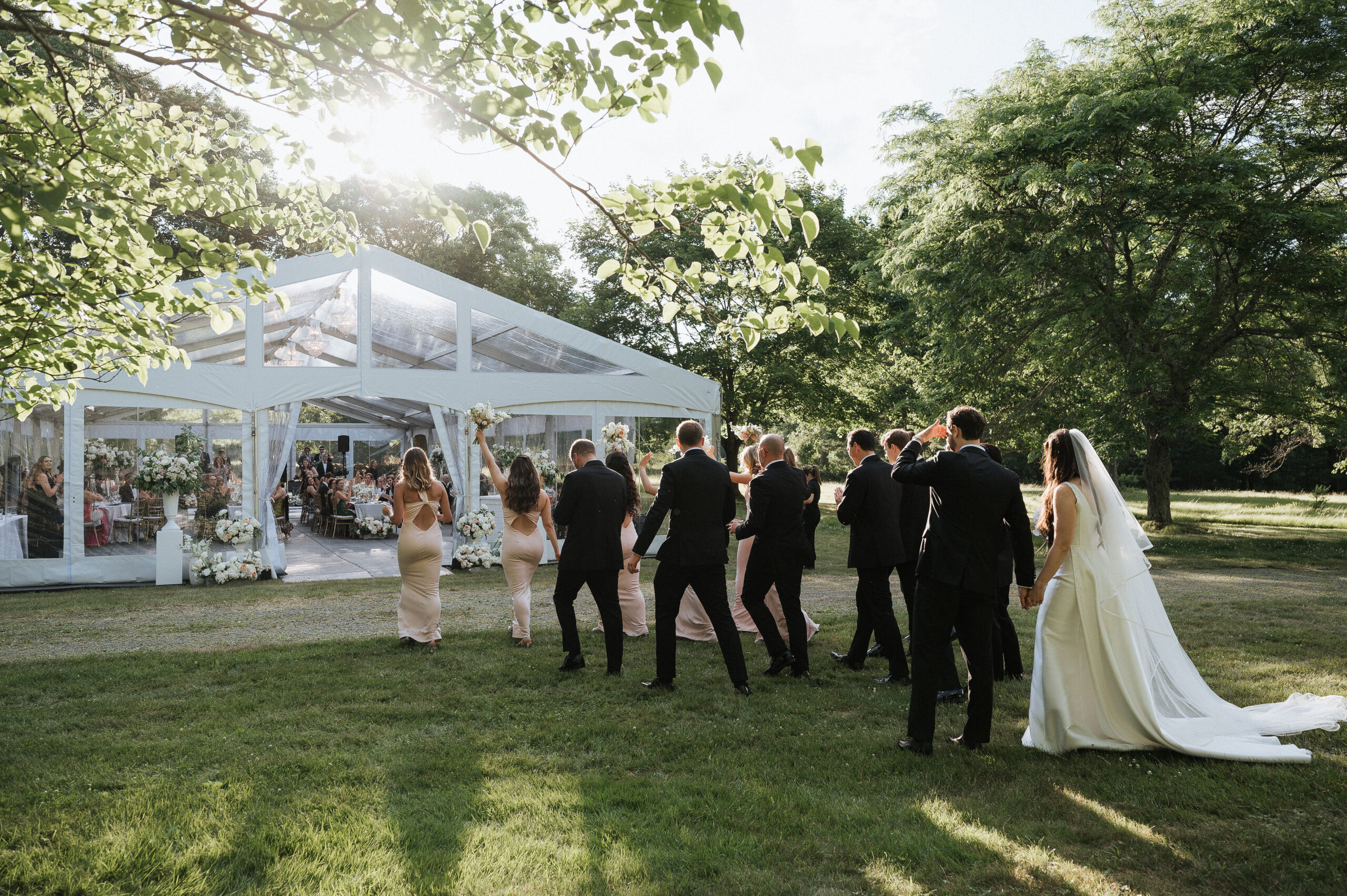
Working at Baystate, I’ve seen firsthand how a tent can completely transform a backyard, field or outdoor property into a wedding venue. I’ve seen simple backyard setups and completely transformed reception spaces with flooring, draping, specialty lighting, bars, lounge furniture and custom layouts.
A tent doesn’t have to dictate what your wedding looks like. It gives you a structure and lets you decide what happens inside it!
Why I Ultimately Chose a Tented Wedding
Funny enough, when I first started looking at wedding venues, I didn’t think I wanted a tent. I work with tents every day, so it almost felt too obvious. I wanted my own wedding to feel different!
But as we toured venues and I started thinking more seriously about what I wanted our reception to actually look and feel like, I kept coming back to the flexibility of a tent.
There are SO many beautiful traditional wedding venues, but you’re ultimately working within an existing space. The flooring is already there. The walls are already there. The layout may have limitations. The lighting, ceiling and overall feel of the room give you a starting point that you then design around.
With a tent, I get to choose that starting point.
We can bring in the flooring we want, choose the lighting and draping, decide exactly where the bar and dance floor go, select our tables and chairs, and create a layout around our wedding rather than adapting our wedding to an existing room.
And because I work with tents every day, I already know how much you can actually do with one. Once I stopped thinking of a tent as the “predictable” choice for me and started looking at it as a completely customizable reception space, it made SO much sense.
The tent isn’t limiting our design. It’s giving us control over it.
Don’t Overlook a Beautiful Backyard or Private Property
If you have access to a beautiful backyard, family property or another outdoor space, don’t automatically assume you need a traditional wedding venue!
One of the coolest things about a tented wedding is that, with the right planning, you can essentially create the venue.
You can choose where the reception goes, how guests move through the property, what the space looks like and which elements you bring in. And if the property already means something to you or your family, there’s an added sentimental value that a traditional venue simply can’t replicate.
That freedom does come with more logistics, though, which is why I would price everything out before deciding a backyard wedding is the right choice.
Is a Backyard Wedding Cheaper Than a Wedding Venue?
Not necessarily. A backyard wedding can save you the cost of a traditional venue fee, but you’re also starting with a property that wasn’t necessarily designed to host 100+ people for dinner and dancing.
Depending on the property and your wedding plans, you will need to bring in a tent, tables and chairs, lighting, a dance floor, restroom trailers, generators or additional power, catering infrastructure, trash removal and even guest transportation or parking solutions.
That doesn’t mean a backyard wedding can’t be a great value. It absolutely can be! You also have to consider what you’re getting in return: more flexibility, way fewer venue restrictions and the ability to create something completely customized.
But “backyard” doesn’t automatically mean “budget.”
Before deciding it’s the cheaper option, get realistic estimates for the major pieces you’ll need and look at the total cost.
Price the whole wedding — not just the venue fee!
10. Before You Book a Wedding Venue: Read The Contract
Knowing how to choose a wedding venue isn’t just about finding one you love — it’s also about understanding exactly what you’re agreeing to. Take the time to actually read the entire contract before you sign or pay your deposit.
I know contracts aren’t the most exciting part of choosing a wedding venue, but this is where everything you’ve been told throughout the process should come together in writing.
Pay attention to the payment schedule, cancellation and postponement policies, food and beverage minimums, required vendors, insurance requirements, damage policies, event timing, getting-ready and rehearsal access, music curfews, setup and cleanup requirements, vendor load-in and load-out, décor restrictions and any additional fees.
And if something doesn’t make sense, ask about it. If something important was discussed during your tour or over email but you don’t see it clearly reflected in the contract, ask about that too.
Don’t rely on assumptions or conversations you vaguely remember having months ago. Make sure you understand exactly what you’re agreeing to.
Your venue will influence so many of the decisions you make afterward, from your vendors and rentals to your timeline and overall budget. It’s worth slowing down at this point and making sure the venue you’ve fallen in love with works just as well on paper as it does in person.
11. How Do You Know You’ve Found the Right Wedding Venue?
After everything I just told you to research, compare, price out and ask about, I also think there’s something to be said for how a venue feels when you’re actually there.
For us, we just knew.
We walked around the property and it felt right. It checked probably 99% of our boxes, we could picture our wedding there, and the things it didn’t have weren’t important enough to outweigh everything it did.
We actually had another venue tour scheduled afterward and still went. If anything, it just confirmed what we already knew.
I don’t think you need to find a venue that checks literally every box on your original list. I’m not even sure that venue exists. But you should understand what you’re compromising on and feel genuinely good about those compromises.
Do your research. Ask all the questions. Understand the costs and the rules. But when you find a venue that checks almost every box and you can actually picture yourselves getting married there, you might just know.
And after everything we went through trying to find ours, I think all of the venues that weren’t the one made us appreciate the one that was even more.
Do You Need a Wedding Planner to Choose a Venue?
If you just read all of this and thought, Samantha, I cannot do this… that’s fair! This is also exactly why wedding planners exist.
A good wedding planner can help you narrow down venues, compare what’s actually included, spot potential logistical issues, understand vendor requirements and ask questions you may not even know to ask yet. They’ve seen enough weddings to know that the tiny detail that sounds insignificant during a tour can become a BIG deal later.
That being said, I know hiring a full-service wedding planner isn’t realistic or necessary for every couple. You may love planning and want to do it yourself, or a planner simply may not fit into your wedding budget.
That’s really who I wrote this guide for!
You don’t need to be a wedding professional to choose a great venue. You just need to know what questions to ask, what to look for and what you’re actually agreeing to before you sign.
And if this article helps you walk into your venue tours feeling a little more prepared, I’ve done my job!
How to Choose a Wedding Venue: FAQs
When Should I Book My Wedding Venue?
Your wedding venue is typically one of the first major vendors you’ll book because it establishes your wedding date and affects many of the vendors and services you’ll need afterward. Start venue shopping once you have an approximate budget, guest count, general location and time of year in mind.
Is It Cheaper to Have a Wedding on a Friday or Sunday?
Sometimes. Wedding venue pricing and food and beverage minimums can vary by day of the week, and some venues offer lower pricing for Friday or Sunday weddings than peak Saturdays. Ask each venue directly because pricing structures vary.
Which Months Are Cheapest for Wedding Venues?
This depends heavily on the venue and location. Some venues offer different rates or minimums during their slower season, while others keep pricing relatively consistent throughout the year. If your date is flexible, ask the venues you’re considering whether they have off-season pricing.
What Are the Hidden Costs of a Wedding Venue?
Potential additional costs include food and beverage minimums, service charges, taxes, required vendors, rentals, restroom trailers, generators, tents, transportation, security, additional staffing and setup or cleanup fees. Ask for a complete list of required expenses before booking.
What Should I Look for When Touring a Wedding Venue?
Look at the property’s actual condition, included furniture, bathrooms, getting-ready spaces, lighting, heating and air conditioning, rain-plan spaces and how comfortably it accommodates your guest count. Also ask which elements you’ve seen in professional wedding photos are actually included with the venue.
Is an All-Inclusive Wedding Venue Worth It?
It can be! All-inclusive venues can simplify wedding planning and bundle many expenses together, while blank-slate venues typically offer more flexibility. The better choice depends on whether you prioritize convenience or customization and whether you actually like the products and vendors included.
Is a Backyard Wedding Cheaper Than a Wedding Venue?
It definitely can be, especially if you’re planning a simpler wedding! But if you’re going all out with a large tent, flooring, lighting, restrooms, power and upgraded rentals, a backyard wedding isn’t automatically going to cost less than a traditional venue.
Final Thoughts on How to Choose a Wedding Venue
If I could give someone newly engaged one piece of advice about how to choose a wedding venue, it would be this:
Figure out what matters to you before you let a beautiful venue tell you what should matter to you.
It is SO easy to walk onto a gorgeous property and immediately start picturing your wedding there. But take the time to look beyond how it photographs. Understand the real cost, learn the rules, research the required vendors, see the rain plan, ask about timing and make sure the space actually works for the wedding you want to have.
Your venue doesn’t need to check every single box. Ours didn’t — but it checked probably 99% of them, and when we were there, we just knew.
The right wedding venue isn’t necessarily the one that looks exactly like the picture you had in your head when you got engaged. It’s the one that gives you the right foundation to create the wedding you actually want.
Planning a Tented Wedding in New England?
If the venue you’re considering requires a tent — or you’re thinking about turning a backyard, private property or outdoor space into your wedding venue — talk to a tent and rental company before you book the property.
At Baystate Tent & Party, we’ve been helping couples create weddings throughout Massachusetts, New Hampshire and New England since 1984. We can help you think through tent size and style, layouts, tables and chairs, flooring, dance floors, lighting and the other rental pieces that go into turning an outdoor space into an actual wedding venue.
And if you’re still deciding between properties, reach out before you sign the venue contract! We’d much rather help you understand what a property will realistically require ahead of time than have you fall in love with a space and discover afterward that the tent or rentals you need don’t work with the site or budget.
Planning a wedding that needs a tent or rentals? Contact Baystate Tent & Party to start talking through your wedding and get a rental estimate.

Wedding Whisperer | Dog Mom | Creative Enthusiast
Samantha has been an integral part of the Baystate Tent & Party team since 2016, combining a lifelong passion for weddings and special events with years of hands-on experience in the event rental industry. She loves helping clients bring their vision to life, balancing creative design with thoughtful planning and attention to detail to create celebrations that feel effortless. Known for building lasting relationships with her clients, Samantha believes every event is unique and enjoys guiding couples through the planning process with honesty, organization, and genuine excitement for their big day. When she’s not talking tents and timelines, Samantha is a true lake girl who enjoys spending time with her black lab, Frankie, soaking up the sunshine, and getting lost in a good romance novel.