
2026 Tent Rental Pricing Guide: What Affects Cost and How to Choose the Right Company
Your Complete, Transparent, Industry-Level Breakdown
(From a 40-Year New England Tent Company)
Hiring a tent company shouldn’t feel confusing or secretive, but pricing in our industry can vary more than most people expect. Two tents that look similar online can cost very different amounts once you see the quote — and there are real reasons why.
Every event is different. Every property is different. And every tent company structures pricing differently. Once you understand the core factors behind cost, it becomes much easier to compare quotes, choose a vendor, and stay within your budget.
This guide breaks down the main factors that affect tent rental pricing, why companies charge different rates, and where Baystate Tent fits in the New England market. It’s honest, simple, and based on 40+ years of industry experience.
TLDR: What You Need to Know
- Tent prices depend on size, site conditions, tent style, labor, and accessories.
- Flooring, heating, and clear tops are the biggest price drivers.
- Flat grass = the most affordable site condition.
- Cheap companies are cheap for a reason (quality, staffing, safety).
- Expensive companies charge more because they invest in equipment, training, and inventory.
- Baystate Tent is priced in the middle — premium quality without luxury pricing.
- Always ask for proof of insurance, DigSafe calls, flame-retardant certificates, and permitting.
- Contact us for quotes; delivery, labor, and tax are always separate.
What Drives Tent Rental Costs Up
Pricing goes beyond “tent size.” The biggest cost factors are:
- Site conditions
- Tent Style
- Additional rental item needs (such as flooring or heat)
- Delivery and pickup schedule
One of the biggest drivers is the property itself. A tent installed on a flat grass lawn will always be the most affordable because the crew can stake easily and lay out equipment without obstacles. When the ground isn’t stakeable — such as asphalt, patios, ledge, or concrete — we have to bring in heavy ballasting, which requires more labor, trucking, and time. Tight backyards, hills, walkways, and limited access will always increase labor costs too.
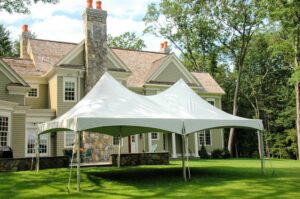
The type of tent also changes the price. Canopy tents are the simplest build, with lightweight poles and easy setup. Frame, clear top and sailcloth tents cost more because of the maintenance and the premium look. Structure tents are on a different level entirely — engineered tents designed for long-term use, snow load, and high wind ratings. Each style is it’s own level of investment for the tent company.
- Canopy tents → least expensive
- Frame tents → mid-range
- Sailcloth tents → premium
- Clear-top tents → high maintenance, higher cost
- Structure tents → engineered luxury-level pricing
Another major factor is weather control. Anytime you need heaters, sidewalls, entry tents, or doors, pricing goes up because there are simply more inventory items being rented. This is especially true for late fall, winter, or early spring events where keeping guests warm becomes part of the design.
Flooring is another upgrade that affects the final bill. It’s beautiful, it feels like a banquet hall, and it changes the entire experience. Whether you choose plywood, DuraTrac, or an elevated floor, flooring is often the biggest add-on outside of the tent itself.
Additional flooring options range from:
- Basic turf
- Carpet
- Faux Sisal
-
Vinyl Wood
Finally, the delivery and pickup schedule matter. Events that require exact timing, immediate takedowns, weekend delivery, or holiday service all require additional labor coordination behind the scenes. If we can deliver and pick up flexibly — for example, anytime Wednesday through Friday, and pick up Monday through Wednesday — the rate will always be lower.
What Helps Keep Tent Rental Costs Down
If you’re trying to stay within a budget, there are a few simple choices that make a big difference.
Keeping the install on flat grass is the easiest way to keep the quote least expensive. Another cost saver is choosing a canopy or standard frame tent instead of a premium tent type such as a clear top or sailcloth. Sticking to basic tables and folding chairs instead of specialty collections also reduces cost quickly.
Another area where customers can save is flexible delivery timing. Allowing us to choose the day based on route efficiency gives you the best possible rate. Choosing to skip flooring also helps if the ground conditions allow it. Many backyard events look beautiful with just a canopy tent, café lights, and linens – but it truly depends on your vision and event type! We work with all budgets.
Why Some Tent Companies Charge Less
Some rental companies are able to offer lower pricing because they operate with smaller teams, limited inventory, or modest warehouse space. They may work with older equipment or have fewer tent styles available, which naturally keeps their costs down. This isn’t necessarily a bad thing — it simply means they serve a different market and may be a good fit for smaller or more casual events.
There are also smaller companies that charge more, not because of premium equipment, but because they take on fewer jobs each weekend. Their pricing reflects their scale rather than the quality or variety of their inventory. It’s one reason pricing in our industry can seem inconsistent when comparing quotes.
Why Some Companies Charge More
Larger, more established companies invest heavily in their inventory, their equipment, and their staff. They operate warehouses, maintain cleaning facilities, run a fleet of trucks, and retain trained installation crews. They carry insurance, follow permitting requirements, and operate by the book — because they have a reputation to maintain.
- Building and Fire Tent Permits
- Digsafe
- Workers Comp and Insurance
- Higher Quality Inventory
- More Experience
- Larger Facilities
Premium companies also own tent styles that are more expensive to purchase and maintain, including clear tops, sailcloth tents, and engineered structures. These tents require more labor, more cleaning, and more expertise, all of which factor into the final price.
Where Baystate Tent Fits
Baystate Tent has been operating in New England for more than 40 years. Over that time, we’ve chosen to position ourselves clearly in the middle: high-quality equipment, modern inventory, fair pricing, and professional crews — without climbing into luxury-tier pricing.
We’ve invested in:
- A full warehouse
- Trained crews
- Cleaning systems
- Updated equipment
- Proper insurance and licensing
- Safe installation practices
- Engineering when required

But we still believe in maintaining approachable, honest pricing. This is why families, universities, municipalities, corporations, and planners feel comfortable choosing us: we’re reliable, high-quality, and transparent without being the most expensive option in the region.
Real Rental Pricing Examples Made Easy
Tent pricing varies based on style and size – here’s a simple snapshot of 40×60 Tents (one of the most common wedding tent sizes). These starting prices do not include delivery, labor, accessories, or tax.
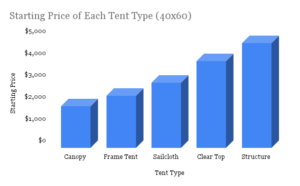
And a common backyard tent, the 20×40 high peak/frame tent, varies across New England from about $700–$900+, with Baystate Tent near the center of that range.
Pricing depends on tent style, size, and site conditions, but here’s a simple way to understand the general ranges. Standard frame tents are one of the most versatile options and can run anywhere from about $220 for a small 10×10 up to around $6,500 for large sizes. Canopy tents cover a wide range too, starting around $340 for a 20×20 and going all the way up to $20,000 for very large configurations.
Sailcloth tents, which are popular for weddings and elegant outdoor events, typically fall between $995 and $6,500, depending on their footprint. Structure tents are in a category of their own: smaller structures may start near $600, but large-scale or long-term installations — especially those used for storage, construction, or winter projects — commonly fall between $30,000 and $100,000 once the full scope is determined.
Seating is a simpler area of pricing. Folding chairs usually range from $2 to $3, while more decorative options, like garden chairs, Chiavari chairs, or cross-back styles, range from $5 to $10.25 depending on the design.
These numbers don’t include delivery, labor, taxes, flooring, heat, or accessories — but they provide a helpful starting point for understanding how different tent styles compare.
What Changed in the Rental Industry After COVID
Across the event industry, costs rose — not just tent rentals. Raw materials, labor, trucking, gas, and cleaning supplies all became more expensive. At Baystate Tent, we try not to raise prices every year. We review pricing only when we need to keep up with rising operation costs while maintaining safe and clean equipment.
Why Paying More Can Actually Save You Money
A tent is not just a product — it’s a product that must withstand wind, weather, and the safety of everyone underneath it. When you hire a reputable company, you’re paying for:
- Safe installation
- Clean, modern tents
- Skilled crews
- Reliable delivery
- Proper certificates
- Experience under pressure
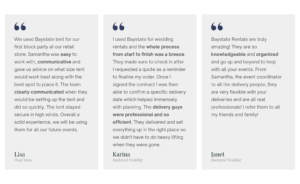
Our customers notice the difference. Here’s what a few of them said:
Tent Rental Pricing FAQ
How much does a tent rental cost?
Most events cost between $1,000 and $6,000 depending on tent style, size, site conditions, and accessories. A 20×20 canopy may start around $340, while a 40×60 frame tent typically ranges from $2,400–$6,000. Structure tents vary widely.
For accurate pricing, we need your event date, location, and tent size. Contact us for a quick, free quote!
Is renting a structure cheaper than buying a building?
Yes — if you need it for under two years, renting is almost always more cost-effective. Structures offer flexibility without long-term ownership costs.
Where do you install?
We mainly service Massachusetts and New Hampshire, but we install across all of New England for larger or long-term projects.
Do I need a permit for my tent?
Yes, 99% of the time. Most towns require tent permits for anything over 400 square feet, or if it is on public property. Boston is a little different and more strict. We’ll tell you exactly what your city or town requires, with the most up to date information (because yes, it does change occasionally!).
Do I need a permit for my tent if it’s on my private property?
Yes. It doesn’t matter if the tent is going in your backyard, you still need to follow the building code. We pull the necessary permits for you!
How long does tent setup take?
Small tents take 1-4 hours, larger tents take 4-8 hours, and structure tents usually require 1–3 days depending on size and site conditions.
Do prices include delivery?
Delivery is separate and based on distance and scheduling. Flexible delivery windows receive the best rate. Contact us for exact pricing!
Can I lower my rental cost?
Yes — choosing a simpler tent, table, and chair styles, skipping flooring, or allowing flexible delivery can all reduce your total.
Why do quotes vary so much between companies?
Each company has different inventory, labor capacity, equipment quality, and safety standards. Pricing reflects experience, overhead, and product quality.
Final Thoughts
Tent pricing doesn’t have to feel complicated. When you know what affects cost — and what separates one company from another — everything becomes clearer. Baystate Tent’s pricing reflects something simple and intentional: high-quality equipment, safe installations, and experienced crews at a fair, mid-range rate.
If you’re planning an event, construction project, festival, or long-term installation and want transparent guidance, we’d love to help!

Wedding Whisperer | Dog Mom | Creative Enthusiast
Samantha has been an integral member of the Baystate Tent team since 2016, combining a lifelong passion for event design with a deep understanding of logistics and client care. Earning her Wedding Planning Certificate from the University of New Hampshire, she brings both creative vision and meticulous attention to detail to every celebration. Samantha excels at orchestrating seamless events, ensuring that each couple’s vision is brought to life with precision and elegance. Outside of work, Samantha is a certified yoga teacher who offers calming bridal yoga sessions, helping couples start their big day with balance and mindfulness. A true lake girl, Samantha spends her downtime soaking up sunshine by the water with her black lab, Frankie, with a good romance novel in hand.